Canada’s two FIFA Team Base Camps prove major-event impact isn’t limited to match venues. Sometimes, the biggest opportunity is behind the scenes.
By Sarah B. Hood
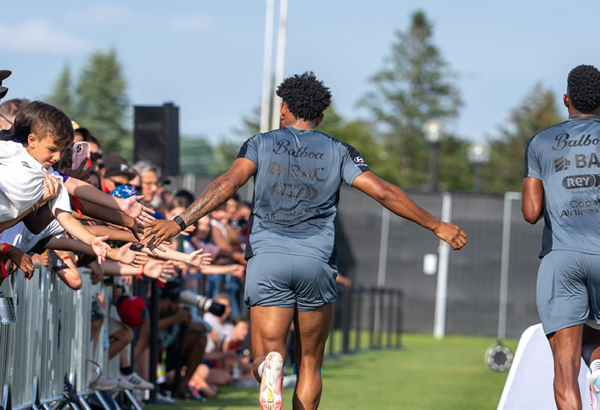
IN 1994, Ontario’s Nottawasaga Resort hosted the German National Team during the FIFA World Cup, so they were ready to step up to host again in 2026—almost.
“We were required to tear apart our main soccer pitch and rebuild it to a FIFA standard,” says Nottawasaga vice-president Dino Biffis. “We had to tear off the top layer, bring in topsoil, regrade it and reconfigure our irrigation system.” Work had to be carried out over the winter of 2025 in carefully timed stages whenever temperatures and precipitation allowed.
“We literally got the grass down on the last day of April [2026], so then we had until the day they started officially, June 11, for it to grow into place,” says Sylvia Biffis, Nottawasaga’s director of group sales and Dino Biffis’s sister.
YEARS IN THE MAKING
The road to becoming a FIFA 2026 venue started years earlier, she explains. Besides soccer, the resort is equipped to host elite-level hockey, rugby, dance and skating events. About 15 years ago, resort representatives began attending annual sports conferences in Ottawa to highlight their facilities, which led to the Alliston, ON, resort being chosen as a 2015 Pan American Games athletes’ village.
Thus, when Canada, the US and Mexico won the FIFA bid in 2018, Canada Soccer recommended Nottawasaga as a potential Team Base Camp venue. FIFA connected the resort with teams that expressed interest, each of which assessed and ranked a shortlist of choices.
The final choice was based partly on the teams’ preferences and partly on other considerations, such as the team’s ranking in world competition and the proximity of their scheduled games to the venue. Once chosen, the resort received considerable support from FIFA—including a dedicated groundskeeper imported from England’s Premier League.
Norway, Croatia and Panama toured Nottawasaga and two of the three ranked it as their number-one choice. “We were the first choice for Norway; they were attracted to our site because of all the greenery around them; it reminded them of home,” Sylvia says, adding that the relative privacy of the resort—a little outside the spotlight of a major urban centre—is also a plus.
Ultimately, Panama’s Men’s National Team selected Nottawasaga as its home base.
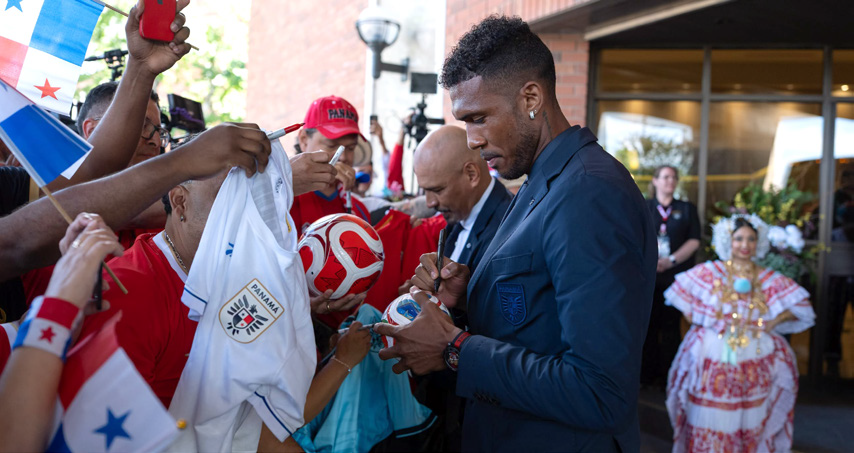
autographs at Nottawasaga Resort
HOME AWAY FROM HOME
“A real feel-good moment was the first day that Panama stepped onto the field,” says Dino. “To see 300-odd families with kids watching the event, and to see the players signing autographs and taking pictures: really great moments.” However, from that point on, “it was all in for three weeks, hands on, no days off,” he says.
“It was their home away from home, but it was also the Nottawasaga family taking care of the Panama family,” says Sylvia. “We are lucky that we have a lot of Spanish-speaking staff who understand the cultural needs and the language. It was sad seeing them go; it was like family members leaving.”
CANADA’S HOME BASE
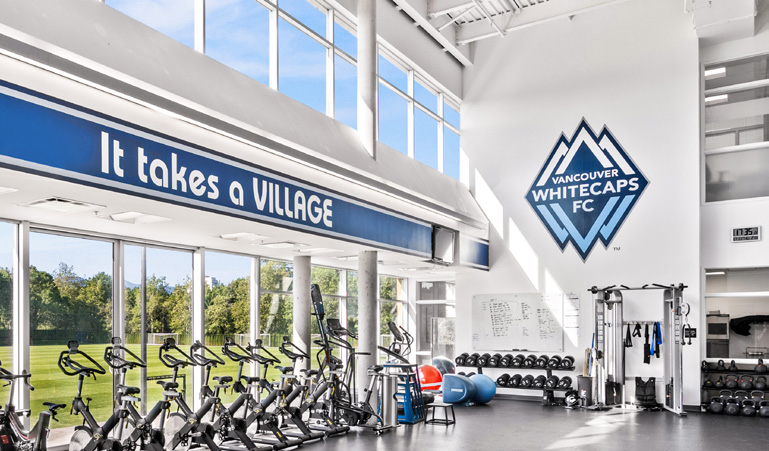
Vancouver’s National Soccer Development Centre was chosen to host Canada’s Men’s National Team. “Knowing that our facility played even a small role in supporting the team ahead of such a historic tournament was incredibly meaningful,” says Axel Schuster, CEO and sporting director for Vancouver’s Whitecaps FC.
The multi-year selection process required close collaboration with FIFA and Canada Soccer. Every aspect of the facility was evaluated, from infrastructure to security, privacy and the pitch itself.
“A key milestone was hosting Canada’s Men’s National Team during its 2025 Concacaf Gold Cup training camp,” Schuster says. “That experience allowed us to test our operational plans in a live environment, refine our processes and ensure we were fully prepared for the demands of serving as a Team Base Camp.”
With a purpose-built facility already in place, he says, “the biggest operational focus was security and access control. We worked closely with FIFA, Canada Soccer, Host City Vancouver and our private security partners to create an environment where players and staff could train with complete privacy and confidence.”
PLAY THE LONG GAME
Schuster says “the biggest lesson is to start early and build strong partnerships. Hosting a Team Base Camp requires close coordination among FIFA, Canada Soccer, local government, security agencies, hospitality partners and venue operators. Success depends on every organization working toward the same goal.”
He emphasizes that planning considerations extend far beyond the training facility itself. Off the field, elite teams expect the same high standards in transportation, security, foodservice, recovery spaces and daily operations as they do of the facility.
A FULL-CIRCLE MOMENT
Schuster recommends using “every opportunity to test your plans,” noting that the knowledge gained during the 2025 Concacaf Gold Cup “provided invaluable operational experience and helped us identify opportunities for improvement before the World Cup.”
For the organization it was especially rewarding, he says, to see several Whitecaps FC alumni on the national team roster. “Watching players who developed within our club represent Canada on the world’s biggest stage reinforced the importance of strong player development pathways and highlighted the connection between the Whitecaps and the national team.”
Photos: Nottawasaga Resort; Vancouver Whitecaps FC
Published October 2026